 Fault-tolerant Quantum Computing
 Optimization
 Computer Architecture
In my spare time, I enjoy running, swimming, hiking and camping, and photography. So far, I have completed three half marathons, with a personal best of 1:42 and one full marathon in 4:43. I also love playing the saxophone in a wind symphony and enjoy classical music—Chopin’s ballades are among my favorite pieces!
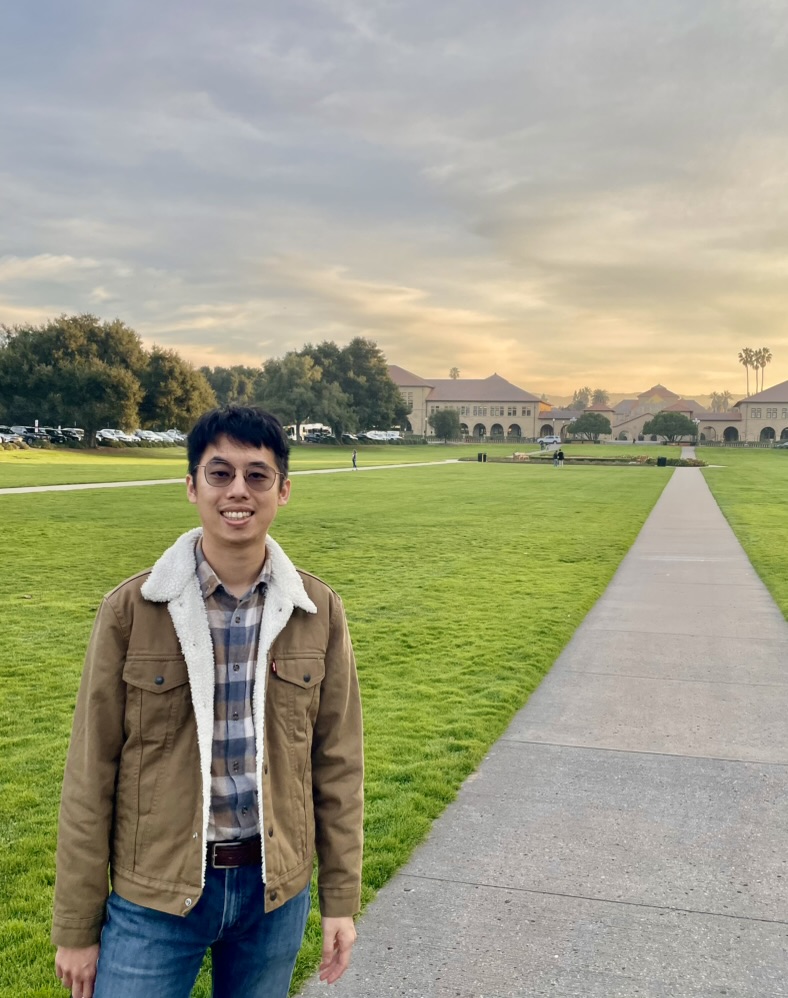
I am a second-year Ph.D. student in Computer Sciences at the University of Wisconsin–Madison, where I am a member of QUEST and the Wisconsin Quantum Institute (WQI). I am fortunate to be advised by Dr. Swamit Tannu. Our research focuses on fault-tolerant quantum computer architecture, including hardware-aware quantum error correction (QEC) schemes, quantum decoders, and resource estimation for early fault-tolerant quantum computers. My current research aims to answer the question: “Do we need to separate computation and memory in quantum computers? If so, how should we design the QEC schemes and architectures to support this separation?”
Before joining UW-Madison, I earned my M.S. in Computer Science from Texas A&M University, where I worked with Dr. Andreas Klappenecker on quantum algorithms and fault-tolerant quantum computing. I earned my B.S. in Computer Science and Information Engineering from National Cheng Kung University in Taiwan, where I worked with Dr. Hung-Kai Wang, Dr. Yu-Chen Shu, and Dr. Matthew Lin on solving the real-world optimization problems with GPUs and quantum-inspired algorithms.
Awarded a Graduate Student Summer Research Fellowship!
I’ll be joining the University of Wisconsin-Madison in fall 2025 to pursue Ph.D. degree.
I passed my thesis defense: Quantum Data-syndrome Codes Toward Measurement-free Fault Tolerance
Awarded Computer Science Fellowship at Texas A&M University!
I’ll be joining Texas A&M University and working with Dr. Andreas Klappenecker to do my master’s degree
I am discharged from my mandatory military service.
I’ll be a research assistant in Math department and working with Dr. Yu-Chen Shu
My paper ’’Multi-subpopulation parallel computing genetic algorithm for the semiconductor packaging scheduling problem with auxiliary resource constraints’’ is published on Applied Soft Computing journal